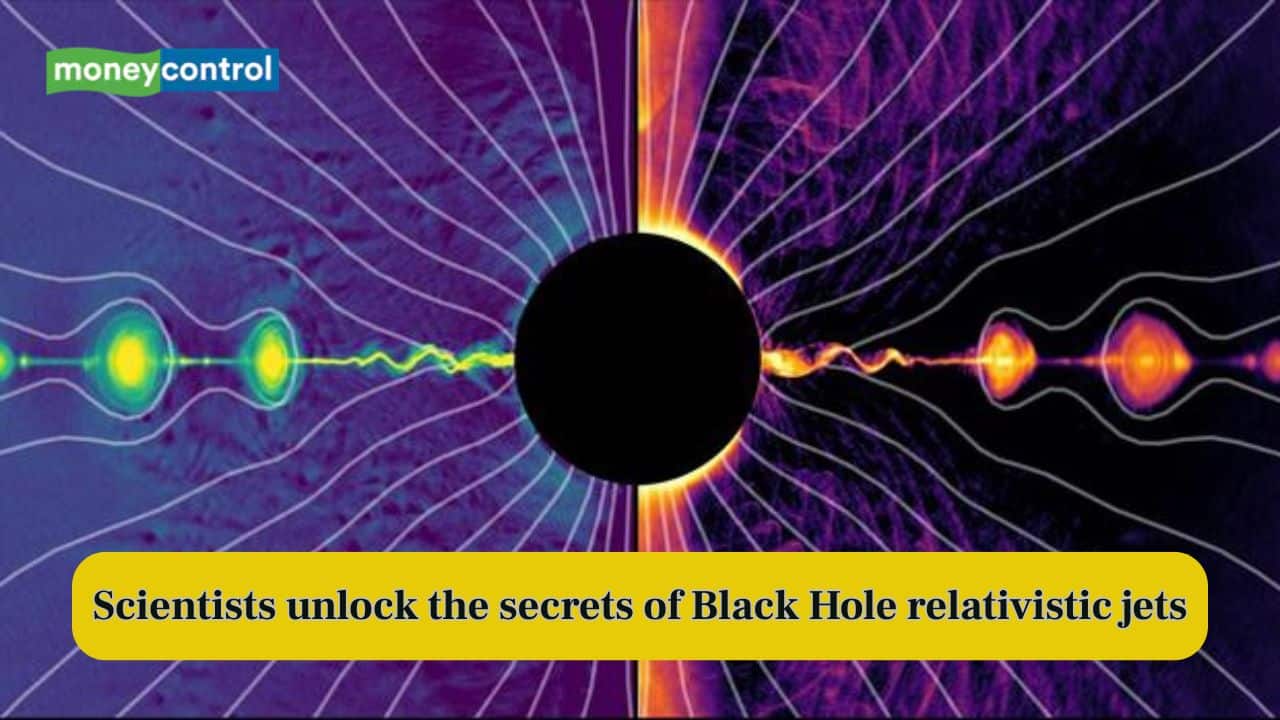
Photo: moneycontrol.com
How black holes produce powerful relativistic jets
Theoretical physicists at Goethe University Frankfurt unveil simulations explaining how black holes generate powerful astrophysical jets, enhancing our understanding of cosmic phenomena.
- The research focuses on Messier 87, a galaxy known for its supermassive black hole, which was first cataloged by Charles Messier in 1781.
- Complex simulations reveal that the magnetic fields around black holes play a crucial role in the formation of relativistic jets composed of plasma.
- This study provides insights into the mechanisms driving astrophysical jets, which can travel at nearly the speed of light, impacting surrounding galaxies.
- The findings could help explain the interaction of black holes with their environments, shedding light on cosmic evolution and the behavior of matter under extreme conditions.
- The simulations conducted by scientists at Goethe University Frankfurt represent a significant advancement in theoretical physics and our understanding of black hole dynamics.
Why It Matters
Understanding how black holes like Messier 87 produce jets is essential for comprehending the universe's structure and evolution. This research impacts astrophysics, potentially influencing future studies on cosmic phenomena. As scientists refine their models, we may uncover new aspects of black hole interactions and their role in galaxy formation.